Cart Path Woes? Get Free Relief & Save Your Clubs!
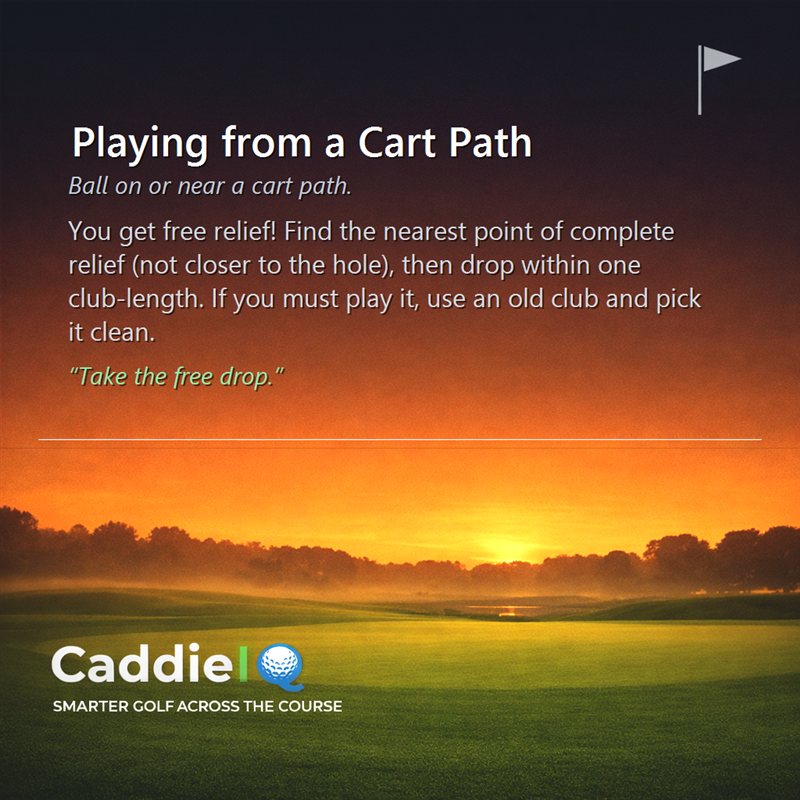
Few things disrupt a good golf round quite like a perfectly struck shot taking an unfortunate bounce onto a hard, unforgiving cart path. That sickening 'clink' sound often brings with it a wave of frustration, but here's some excellent news: the Rules of Golf are on your side! This isn't a penalty situation; it's an opportunity for free relief.
Why Your Ball Lands on the Path
Whether it's an errant drive, a pushed approach, or just a cruel bounce, golf balls frequently find their way onto cart paths. These paved or gravelled surfaces are integral to course navigation but are also 'immovable obstructions' under the Rules of Golf, meaning you're entitled to relief.
The Fix: Step-by-Step Free Relief
The Rules of Golf, specifically Rule 16.1 (Abnormal Course Conditions), classify a cart path as an 'immovable obstruction.' This means you're entitled to free relief without penalty. Here’s how to correctly navigate this common scenario:
- Identify the Nearest Point of Complete Relief (NPCR): This is the most crucial step. The NPCR is the spot where both your ball and your stance are entirely clear of the cart path. It must be in the general area (fairway, rough, etc.) and crucially, not closer to the hole than where your ball originally lay. Visualise your stance and swing; both must be free of interference.
- Mark Your Spot: Once you've precisely identified your NPCR, mark it clearly with a tee or ball marker.
- Establish Your Relief Area: From your NPCR, you are allowed one club-length of relief. This club-length must be measured using the longest club in your bag (excluding your putter) and must stay within the same area of the course (e.g., general area) and not closer to the hole than your NPCR.
- Drop Your Ball: Stand upright and drop the ball from knee height. The ball must land in and come to rest within your one club-length relief area. If it rolls out, you re-drop. If it rolls out a second time, you place it where it first touched the ground when re-dropping.
When You Must Play From the Path
While taking free relief is almost always the smartest move, there might be rare situations where it’s simply not feasible, perhaps due to the path running through a penalty area or an unplayable lie after relief. If you absolutely must play from the path:
- Use an Old Club: This is paramount. Hitting a golf ball off a hard surface like concrete or asphalt will severely damage your clubface, potentially bending or breaking it. Grab an older iron or even a hybrid you don't mind sacrificing.
- Pick It Clean: Before striking, carefully clean any debris from around the ball and the path itself. Even a tiny pebble can cause unpredictable deflections and further club damage.
- Swing Smoothly: Focus on a controlled, shallow swing, aiming to pick the ball cleanly off the surface rather than hitting down on it. Your goal is simply to get the ball back into play without further incident.
Practice Your Drop
The best drill for cart path relief is mental preparation. On your next practice round, intentionally place a ball on a cart path (when no one is behind you, of course!). Go through the entire relief process: find your NPCR, measure your club-length, and execute the drop. Practising this without pressure will build confidence and speed up your decision-making during a competitive round. Remember, CaddieIQ can help you visualise course layouts and potential relief areas, making these decisions even quicker.
Play Smart, Protect Your Gear
Knowing the rules around cart path relief not only saves you strokes but also protects your valuable equipment and keeps your round flowing. Don't hesitate to take your free drop; it's a fundamental part of playing smart golf.
Related tips
Get this kind of advice on every shot
CaddieIQ is your free AI golf caddie - instant club & shot advice, swing fixes and a daily tip.
Try CaddieIQ free