Unplayable Ball in Golf: Your 3 Relief Options Explained
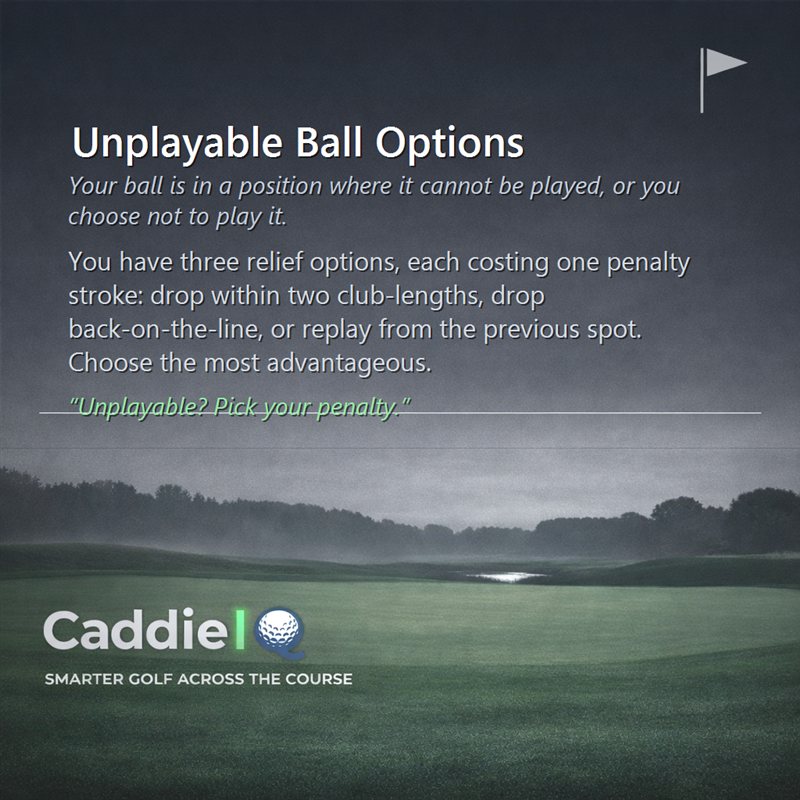
There are few things more frustrating in golf than hitting a decent shot only to find your ball in an impossible position. Whether it’s buried deep in a bush, nestled against an immovable obstruction, or precariously perched on a slope, sometimes playing the ball as it lies simply isn't an option. This is where the "unplayable ball" rule comes into play, offering a lifeline to escape a dire situation – for the cost of just one penalty stroke.
Why Your Ball Might Be Unplayable
An unplayable lie isn't always about physical impossibility; it's often a strategic decision. You might choose to declare your ball unplayable if:
- It's in thick gorse or deep, matted rough where a clean strike is impossible.
- It's up against a fence, tree, or other obstruction from which you can't reasonably swing.
- It's in a bunker with an impossible stance or a lie that guarantees a poor outcome.
- The risk of injury (e.g., hitting roots) outweighs the benefit of attempting a shot.
- You simply believe that any attempt to play it would result in a worse outcome than taking a penalty.
Remember, it's entirely your call to declare your ball unplayable, anywhere on the course except when it's in a penalty area (where different rules apply).
Your Three Unplayable Ball Relief Options
Once you’ve decided your ball is unplayable, you have three distinct relief options, each incurring a one-stroke penalty. The key is to choose the option that gives you the best chance for your next shot.
1. Drop Within Two Club-Lengths
This is often the most straightforward option. You can drop your original ball or another ball within two club-lengths of where your ball lies, no closer to the hole. When measuring, use the longest club in your bag, excluding your putter. The ball must be dropped from knee height and come to rest within that relief area.
2. Drop Back-on-the-Line
This option allows you to go back as far as you want. You must identify the spot where your ball lies (or where it last crossed the edge of the general area if it's out of bounds) and draw an imaginary line back from the hole through that spot. You can then drop a ball on that line, as far back as you wish, ensuring it's no closer to the hole. The ball must be dropped within one club-length of where it first touches the ground on that line.
3. Replay from the Previous Spot
This is the "stroke-and-distance" option. You can choose to go back to the spot where you made your previous stroke and play another ball from there. This is essentially playing three off the tee if your drive was unplayable, or playing your third shot from the fairway if your second shot landed in an unplayable spot. This option is particularly useful if the other two don't offer a clear path to the green.
Making the Smart Choice: A Mental Drill
Before you commit to an option, take a moment to assess the situation. Visualise each of the three scenarios: Where would the ball lie? What kind of shot would you have? How far would you be from the hole? Consider the terrain, hazards, and your strengths. Sometimes, going back further with the "back-on-the-line" option gives you a much better angle and lie, even if it means a longer shot. Don't rush the decision. An app like CaddieIQ can even help you weigh your options by providing optimal strategy based on your position and the course layout.
Mastering the Rules, Mastering Your Game
Knowing your unplayable ball options is a vital part of golf course management. It allows you to minimise damage from a poor lie and get back in play efficiently. Don't let an unplayable lie ruin your round; use the rules to your advantage and keep your score respectable.
Related tips
Get this kind of advice on every shot
CaddieIQ is your free AI golf caddie - instant club & shot advice, swing fixes and a daily tip.
Try CaddieIQ free