Golf Rules: Movable vs. Immovable Obstructions Explained
Ever found your perfectly struck golf ball nestled right next to a sprinkler head, or perhaps a rogue rake left by a previous group? It’s a common frustration that can leave golfers scratching their heads, wondering what the correct next step is. Knowing the rules regarding obstructions isn't just about avoiding penalties; it's about playing fairly and efficiently.
Golf courses are dynamic environments, a blend of natural landscapes and man-made elements. While greens and fairways are manicured, the presence of maintenance equipment, course furniture, and irrigation systems is unavoidable. Your ball, in its unpredictable journey, can easily end up in close proximity to these objects. Understanding how to proceed without gaining an unfair advantage, or inadvertently penalising yourself, is crucial for maintaining pace of play and upholding the spirit of the game.
The key distinction lies in whether an obstruction is "movable" or "immovable."
Movable Obstructions: The Simple Solution
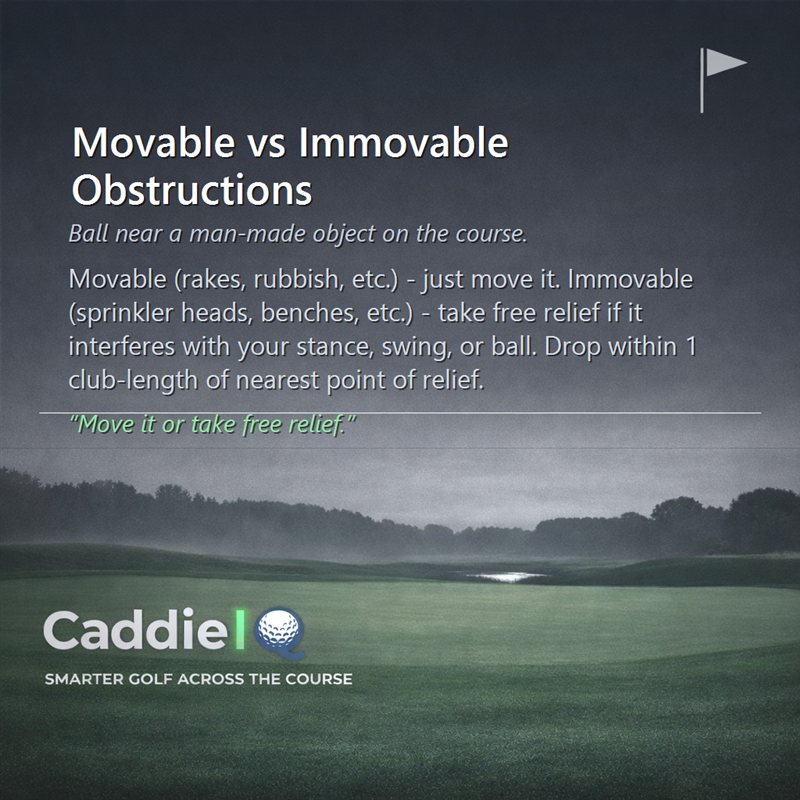
A movable obstruction is any artificial object on the course that can be moved with reasonable effort and without damaging the course. Examples include rakes, rubbish, empty bottles, loose benches, and even some advertising signs. If your ball, stance, or area of intended swing is interfered with by a movable obstruction:
- Identify: Confirm the object is indeed movable.
- Move It: Simply pick it up and move it out of the way. If your ball moves while doing so, there is no penalty, and you must replace the ball on its original spot.
- Play On: Take your shot from the original lie.
Immovable Obstructions: Taking Free Relief
Immovable obstructions are artificial objects that cannot be moved without unreasonable effort or causing damage. Common examples include sprinkler heads, drainage covers, fixed benches, cart paths, roads, and permanent buildings. If an immovable obstruction interferes with your ball's lie, your stance, or your area of intended swing, you are entitled to free relief.
Here’s how to take free relief correctly:
- Determine Interference: Ensure the obstruction genuinely interferes with your stance, the area of your intended swing, or where your ball lies. Visual interference alone is not enough.
- Find the Nearest Point of Complete Relief (NPCR): This is the spot on the course, no closer to the hole, where the obstruction no longer interferes with your ball's lie, your stance, or your area of intended swing. It's often helpful to mimic your address position to accurately identify this point.
- Establish the Relief Area: From the NPCR, your relief area extends one club-length, no closer to the hole. The NPCR itself is part of this area.
- Drop Your Ball: Drop the ball from knee height anywhere within this one club-length relief area. The ball must come to rest within the relief area. If it rolls out, you re-drop. If it rolls out a second time, you place it where it first touched the ground in the relief area.
Remember, this relief is always free of penalty. Knowing these nuances can save you strokes and keep your round flowing smoothly. If you're ever unsure about a specific situation, consulting a rulebook or using an AI caddie app like CaddieIQ (caddieiq.golf) can provide instant clarification.
While you can't practice hitting balls next to obstructions on the range, you can practice the mental aspect. During your next round, whenever you encounter an obstruction, even if your ball isn't near it, mentally run through the process: "Is this movable or immovable? If my ball were here, where would the NPCR be? How would I drop?" This mental rehearsal will make the actual scenario feel less daunting when it arises.
Mastering the rules around movable and immovable obstructions is a fundamental part of becoming a more confident and competent golfer. It ensures you play fairly, avoid unnecessary penalties, and maintain good pace of play. Keep these guidelines in mind, and you'll navigate these common course challenges like a seasoned pro.
Related tips
Get this kind of advice on every shot
CaddieIQ is your free AI golf caddie - instant club & shot advice, swing fixes and a daily tip.
Try CaddieIQ free