Understanding Golf Handicap Allowances by Format
Ever found yourself on the first tee, scorecard in hand, wondering exactly how many shots you’re entitled to? You’re not alone. Understanding golf handicap allowances by format is crucial for fair and enjoyable competition. Getting it wrong can lead to confusion and unfair play. Let’s demystify the rules so you can focus on your swing, not your maths.
Why Golf Handicap Allowances Vary by Format
Golf offers a variety of formats, each designed to test different skills and encourage team play. The handicap system adapts to ensure a level playing field in every scenario. Applying a full handicap to every player in a team event, for instance, could give higher handicappers an undue advantage. Different allowances exist to maintain fairness and competitiveness across all game types.
Understanding Individual Stroke Play & Stableford Allowances
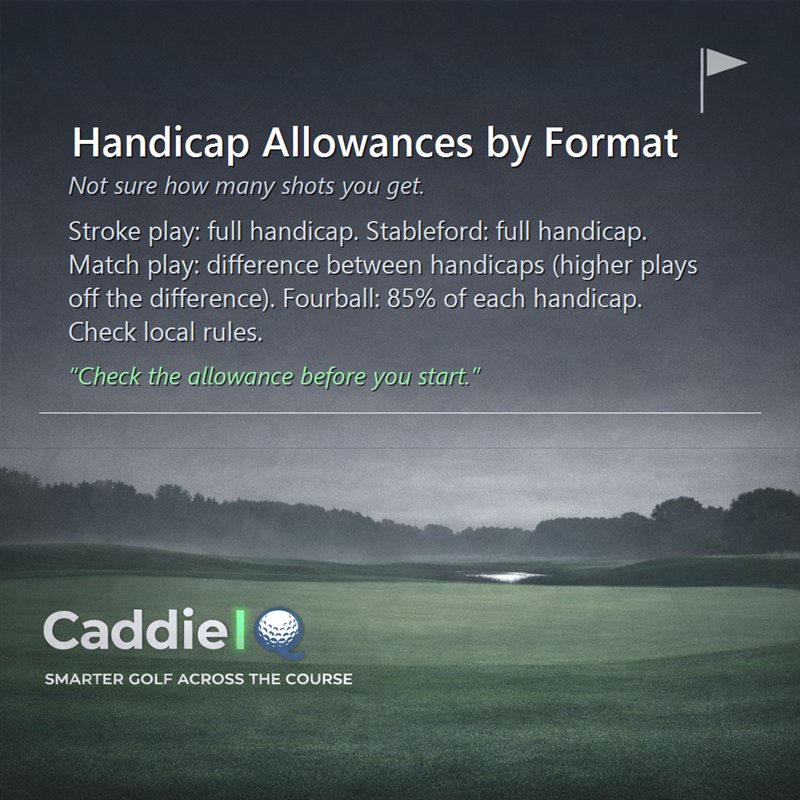
- Allowance: 100% of your Course Handicap.
In individual competitions like Stroke Play (where every shot counts) and Stableford (scoring points based on net score per hole), you receive your full Course Handicap. This allows every player, regardless of ability, to compete against the course and each other on an equal footing over 18 holes. It's the most straightforward application of your handicap.
Match Play Handicap Rules Explained
- Allowance: Difference between handicaps.
Match play is a thrilling head-to-head battle. To ensure fairness, the higher handicapper receives shots equal to the difference between their Course Handicap and their opponent's. For example, if Player A has a Course Handicap of 8 and Player B has 15, Player B receives 7 shots (15-8). These shots are typically taken on the hardest holes as indicated by the stroke index on the scorecard, ensuring strategic fairness.
Fourball (Betterball) Handicap Allowances
- Allowance: 85% of each player's Course Handicap.
In a Fourball competition, two partners play their own ball, and the better net score of the two is recorded for the team on each hole. Because you have a partner whose good shots can cover your less successful ones, the allowance is reduced to 85% of each player's Course Handicap. This prevents a team from gaining an excessive advantage. Remember to round your calculated handicap allowance to the nearest whole number.
Handicap Rules for Other Common Formats
It's good to be aware of allowances for other popular formats:
- Foursomes: Partners play one ball, taking alternate shots. The team receives 60% of their combined Course Handicaps.
- Greensomes: Both partners drive, choose the best drive, then play alternate shots. The team receives 60% of the lower Course Handicap plus 40% of the higher Course Handicap.
Always remember to check the specific Terms of Competition for any event, as local rules or specific club decisions can sometimes alter these standard allowances.
Your Essential Pre-Round Handicap Checklist
To avoid confusion and ensure fair play, make it a habit to perform a quick handicap check before every round:
- Identify the Format: Confirm if it's Stroke Play, Match Play, Fourball, or another format.
- Consult the Rules: Apply the correct percentage or calculation based on the format's requirements.
- Verify with Partners/Officials: If in doubt, ask your playing partners or a competition official for clarification.
- Use a Digital Caddie: Apps like CaddieIQ can instantly calculate your allowance for various formats, ensuring you always know exactly how many shots you get before you tee off.
Understanding handicap allowances isn't just about following rules; it's about embracing fair competition and enhancing your enjoyment of the game. Knowing you're playing on a level playing field allows you to focus purely on your golf, making every shot count and every round more rewarding. Step onto the tee confident in your allowance and ready to play your best.
Related tips
Get this kind of advice on every shot
CaddieIQ is your free AI golf caddie - instant club & shot advice, swing fixes and a daily tip.
Try CaddieIQ free