Mastering Hard Sand Bunker Shots: The Pro's Fix
Few shots in golf test a player's nerve quite like a bunker shot, especially when facing the dreaded hard or thin sand lie. That moment of dread as your club hits the unyielding surface, sending the ball rocketing over the green – we've all been there. But fear not, escaping these challenging lies is entirely possible with the right technique and a subtle shift in your approach.
Understanding the Hard Sand Challenge
The standard bunker shot technique relies on the club's bounce (the angle on the sole) to slide through soft sand, lifting the ball out. When the sand is thin or hard-packed, this technique backfires spectacularly. Opening the clubface, as is common in soft sand, increases the effective bounce. Upon impact with hard sand, the club's bounce "skips" or "bounces" off the surface, making direct contact with the ball's equator or top. The result? A skulled shot that flies low, hot, and far beyond your target.
Essentially, the club cannot penetrate the hard sand as it would soft sand, leading to a loss of control and often a disastrous outcome.
The Fix: Your Step-by-Step Guide
To conquer hard sand bunkers, we need to adapt our strategy to minimise bounce and ensure the club can dig just enough to get the ball airborne with control.
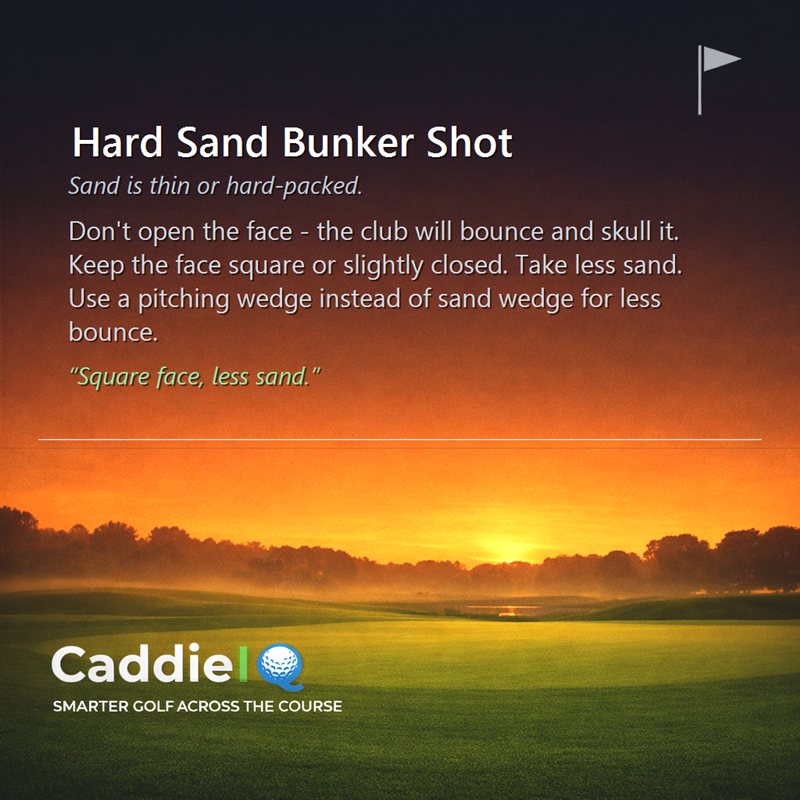
- Club Selection is Key: Forget your sand wedge for this shot. Its high bounce is your enemy here. Instead, reach for a pitching wedge or even a 9-iron. These clubs have significantly less bounce, allowing the leading edge to dig more effectively into the firmer sand.
- Square or Slightly Closed Clubface: This is perhaps the most crucial adjustment. Do NOT open the clubface. Keep it square to your target, or even slightly closed. This reduces the effective bounce, allowing the leading edge to cut through the thin layer of sand rather than bouncing off it.
- Normal Setup, Less Dig: Adopt your usual bunker setup – feet dug in for stability, ball slightly forward of centre. However, resist the urge to dig your feet in excessively, as this might encourage a steeper swing that's harder to control on hard ground.
- Focus on Less Sand: Your swing thought should be "square face, less sand." Instead of trying to take a large cushion of sand, aim to hit just behind the ball, taking only a very thin layer of sand. Think of it more like a firm chip shot from a tight lie, but with a slight downward strike.
- Controlled, Decelerated Swing: While you still need a committed swing, avoid an overly aggressive chop. A smoother, more controlled swing, focusing on accelerating through impact, will help maintain the clubface angle and prevent premature bouncing. The goal is to slide the club under the ball with minimal resistance.
Practise Drill: Mastering the Shallow Divot
To get a feel for this technique, head to the practice bunker:
- Draw a clear line in the sand.
- Set up with a pitching wedge, clubface square.
- Practise hitting just behind the line, aiming to take only a very shallow "stripe" of sand. Focus on the leading edge cutting into the sand, not the sole bouncing.
- Repeat until you consistently take a small, thin divot of sand from just behind the line.
This drill trains your hands and eyes to understand the precise interaction needed between the club and the firm sand.
Conquer the Hard Sand Bunker
Hard sand bunker shots no longer need to be a source of fear. By understanding why conventional methods fail and adapting your club selection and clubface angle, you can confidently navigate these challenging lies. Remember: square face, less sand, and trust your pitching wedge. For personalised feedback on your bunker play or any aspect of your game, remember CaddieIQ is your free AI golf caddie, ready to help you refine your technique and lower your scores.
Related tips
Get this kind of advice on every shot
CaddieIQ is your free AI golf caddie - instant club & shot advice, swing fixes and a daily tip.
Try CaddieIQ free