Master Your Iron Strike: Steep vs. Shallow Explained
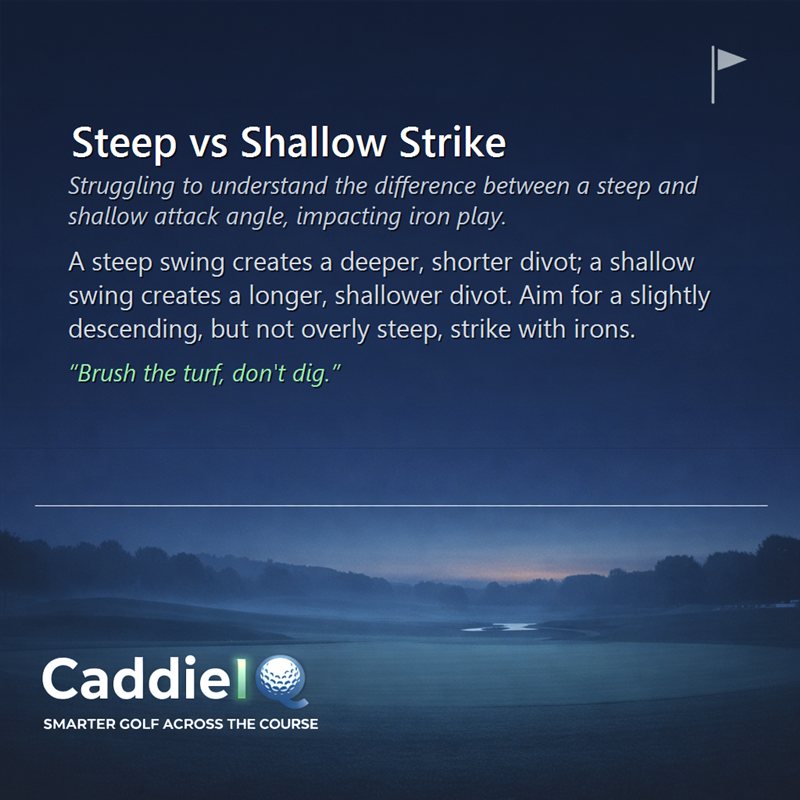
Are you consistently frustrated by fat or thin iron shots? Do you struggle to achieve that coveted crisp contact that sends the ball soaring towards your target? Often, the root cause lies in your angle of attack – specifically, whether your swing is too steep or too shallow. Understanding this fundamental concept is crucial for elevating your iron play.
What's Happening: Steep vs. Shallow Attack Angle
Your attack angle refers to the vertical direction of your clubhead as it approaches the ball at impact. It dictates the interaction between the club, ball, and turf, directly influencing the quality of your strike.
- A Steep Swing: This occurs when your clubhead descends too sharply into the ball. The result is typically a deep, short divot that starts before the ball. While a descending blow is necessary for irons, excessive steepness often leads to "fat" shots where you hit the ground significantly before the ball, losing power and distance. It can also cause pulls or hooks due to the club digging in.
- A Shallow Swing: Conversely, a shallow swing sees the clubhead approaching the ball on a flatter, more sweeping path. The divot, if present, will be long and very shallow, sometimes even just a scuff. An overly shallow angle can lead to "thin" or "bladed" shots, where you hit the top half of the ball, resulting in a low, uncontrolled flight. It can also cause pushes or slices.
The ideal iron strike is a slightly descending blow, where the club makes contact with the ball first, then takes a shallow divot just after the ball. This ensures optimal compression and energy transfer.
The Fix: Achieving the Ideal "Brush the Turf" Strike
Your goal with irons should be to "brush the turf, don't dig." This swing thought encapsulates the perfect balance for a controlled, powerful strike.
Here’s how to work towards it:
- Ball Position: For mid-irons, position the ball roughly in the middle of your stance, or slightly forward of centre. This encourages a natural descending blow.
- Weight Distribution: At address, feel slightly more weight (around 55-60%) on your lead foot. This pre-sets your body to shift correctly and promotes a downward strike.
- Maintain Width in Backswing: Avoid immediately lifting the club upwards. Focus on taking the club away with width, keeping your hands and arms extended. This helps create a broader swing arc, which is less prone to becoming overly steep.
- Controlled Downswing Transition: From the top, initiate the downswing with your lower body, rotating your hips towards the target. Feel like your hands are dropping rather than throwing the club at the ball. This encourages the club to approach from slightly inside and on a shallower plane.
- Impact Sensation: Focus on hitting the ball first, then taking a small, shallow divot immediately after. Imagine you're trying to pinch the ball off the turf. Your hands should be slightly ahead of the clubhead at impact (forward shaft lean).
Practice Drill: The Tee Drill for Perfect Divots
This simple drill will help you understand and feel the correct attack angle:
- Place a golf tee about 2-3 inches in front of your golf ball.
- Set up as usual and hit your iron shot.
- Your objective is to hit the ball first, then take a divot that starts just after where the ball was, and ideally, knock over the tee in front of it.
If your divot starts before the ball, you're too steep. If you don't take a divot or hit the tee, you might be too shallow. Adjust your swing until you consistently hit the ball cleanly and take a shallow divot that starts after the ball and disturbs the tee.
Mastering your attack angle takes practice, but the rewards are immense: more consistent contact, better distance control, and improved ball flight. Don't guess; understand your swing and make informed adjustments. For deeper insights into your swing mechanics and shot data, consider using a free AI golf caddie app like CaddieIQ. It can help you track your progress and reinforce these critical improvements.
Related tips
Get this kind of advice on every shot
CaddieIQ is your free AI golf caddie - instant club & shot advice, swing fixes and a daily tip.
Try CaddieIQ free