Master Your Divots: Unlock Consistent Golf Shots
Are your golf shots inconsistent? Do you struggle with fat or thin contact, leaving you frustrated and guessing at your next outcome? The secret to unlocking more consistent, powerful, and accurate golf shots often lies hidden in plain sight: your divot. Mastering divot control is a fundamental skill that separates good ball strikers from the rest.
Why Inconsistent Divots Sabotage Your Game
An inconsistent divot is a clear indicator of a flaw in your impact dynamics. If your divot is too deep, too shallow, or pointing erratically, it means your club isn't meeting the ball optimally. Common culprits include:
- Improper Angle of Attack: Striking too steeply (taking a huge chunk of turf) or too shallowly (skimming the top or hitting thin).
- Poor Weight Transfer: Failing to shift your weight correctly through impact can cause you to hit behind the ball (fat) or catch it on the upswing prematurely (thin).
- Incorrect Club Path: A divot pointing left or right of your target signals an out-to-in or in-to-out swing path, leading to pulls, pushes, slices, or hooks.
These inconsistencies lead to varied distances, unpredictable direction, and that dreaded "clunky" feeling instead of crisp contact.
The Fix: Ball First, Then Turf
The golden rule for solid iron play is to strike the ball first, then the turf. A perfect divot starts just after where the ball was, is relatively shallow, and consistently points directly at your target. This indicates a descending blow with a square clubface and a controlled club path.
Step-by-Step for Better Divots
- Setup for Success: Ensure your ball position is correct for the club you're hitting – generally around the middle for short irons, moving slightly forward for longer irons. At address, feel a slight bias of your weight towards your lead foot (e.g., 55-45%).
- Focus on Rotation: During your downswing, concentrate on rotating your hips and torso towards the target. This rotational movement helps bring the club down on the correct plane and ensures your hands lead the clubhead slightly into impact.
- Weight Transfer: As you strike the ball, your weight should be predominantly on your lead side. This allows for a naturally descending blow, ensuring you hit the ball before the turf.
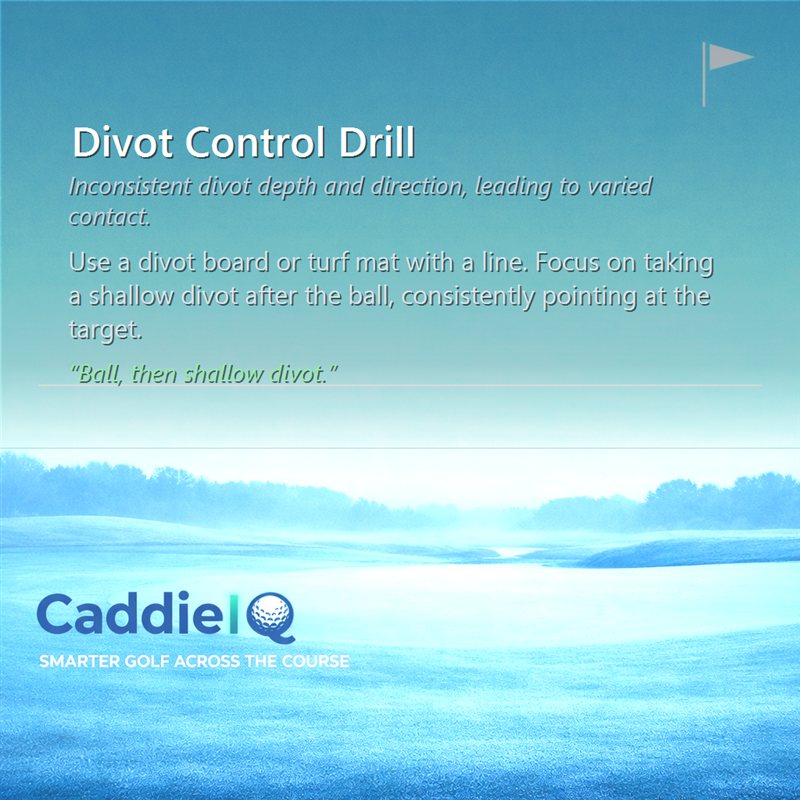
The CaddieIQ Divot Control Drill
This drill is simple yet incredibly effective for ingraining proper impact mechanics:
- Gather Your Tools: You'll need a divot board, a turf mat with a marked line, or even just some chalk or spray paint if you're on a grass range.
- Set Up: Place a golf ball directly in front of the marked line. The line should be perpendicular to your target line.
- Execute the Swing: Address the ball as normal. Your primary swing thought should be: "Ball, then shallow divot." Focus on hitting the ball cleanly and then taking a small, consistent divot after the line.
- Analyse Your Feedback:
- Divot Before the Line? You're likely hitting fat, indicating you're probably not shifting your weight effectively or are casting the club.
- Divot Too Deep? Your angle of attack is too steep. Focus on a slightly shallower entry.
- Divot Points Left or Right? Your club path is off. A divot pointing left (for a right-handed golfer) indicates an out-to-in path; pointing right suggests an in-to-out path. This is where tools like CaddieIQ can be invaluable, helping you analyse your swing path and impact data to make precise adjustments.
- No Divot? You might be hitting thin or picking the ball clean. While sometimes acceptable, for irons, a slight divot indicates solid, descending contact.
Consistently practising this drill will train your body to deliver the clubhead precisely, ensuring that crucial "ball first" contact. The goal is a shallow, consistent divot that starts after the ball and points squarely at your target.
Unlock Your Potential
Mastering divot control is more than just a technical adjustment; it's a pathway to greater confidence and enjoyment on the golf course. By understanding and controlling your divots, you'll gain a deeper insight into your swing mechanics, leading to more consistent ball striking, improved distance, and pinpoint accuracy. Practise this drill regularly, and watch your game transform.
Related tips
Get this kind of advice on every shot
CaddieIQ is your free AI golf caddie - instant club & shot advice, swing fixes and a daily tip.
Try CaddieIQ free