Master Your Golf Grip Pressure: The Toothpaste Tube Analogy
Struggling to find that sweet spot between a death grip and feeling like your club might fly out of your hands mid-swing? Grip pressure is one of the most overlooked yet critical fundamentals in golf, directly impacting your feel, power, and consistency. Many golfers never quite master it, leading to a host of other swing issues. Let's fix that.
Why Too Much Grip Pressure Hurts Your Game
It's natural to want to grip the club tightly. We instinctively fear losing control, especially when trying to generate maximum power. However, this instinct is counterproductive. A tight grip stiffens your forearms and wrists, preventing the natural hinge and unhinge motion crucial for clubhead speed. This stiffness kills your ability to feel the clubhead throughout the swing, making it harder to time your impact and control the clubface. You lose both power and precision.
The Toothpaste Tube Analogy: Your Grip Pressure Fix
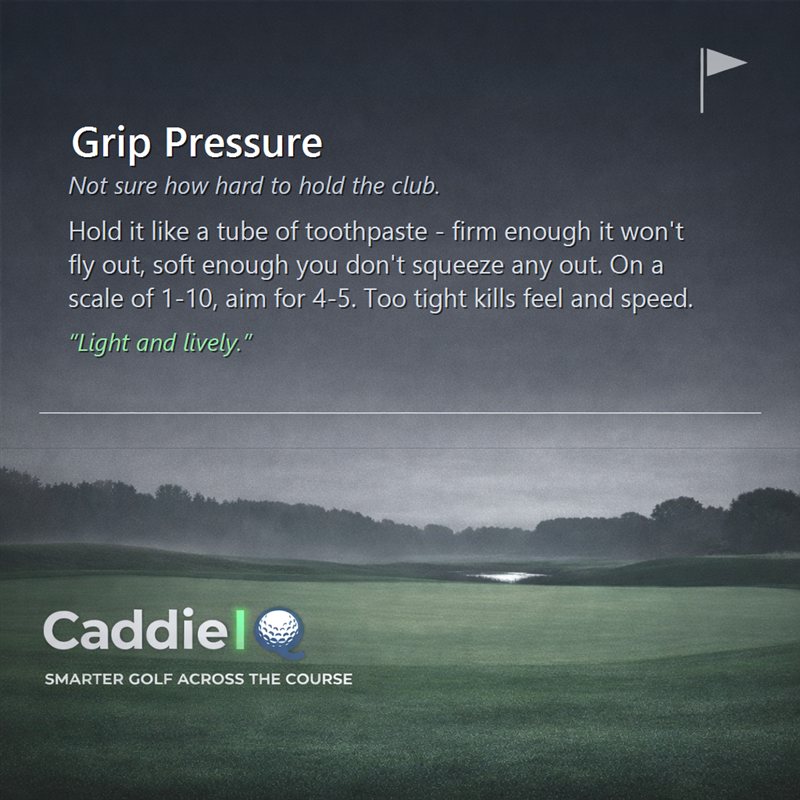
The perfect grip pressure is often described using the 'toothpaste tube' analogy, and it's incredibly effective. Imagine you're holding a tube of toothpaste:
- Firm Enough: You need to hold it securely so it won't slip or fly out of your hands during the swing.
- Soft Enough: You don't want to squeeze any toothpaste out. This means your muscles should be relaxed, not tensed.
On a scale of 1 to 10, where 1 is barely holding it and 10 is a white-knuckle death grip, aim for a 4 or 5. This 'light and lively' feeling allows your wrists to hinge freely, your arms to swing naturally, and the clubhead to accelerate properly through impact.
How to Achieve the Ideal Grip Pressure
- Start Loose: When you first take your grip, consciously feel how loose your hands are. Then, gradually increase the pressure until it feels secure but not tense.
- Wiggle Your Fingers: At address, try wiggling your fingers slightly. If you can't, your grip is too tight. This simple check helps ensure your hands aren't locked up.
- Feel the Clubhead: With a lighter grip, you should be able to feel the weight of the clubhead throughout your swing. This 'feel' is vital for timing and rhythm.
- Relax Your Forearms: Check for tension in your forearms. If they're rock hard, ease off the grip pressure. Relaxed forearms are key to a fluid swing.
Practice Drill: The One-Handed Swing
This drill is excellent for developing a better feel for grip pressure:
- Start with Putting: Practise putting with just your lead hand (left hand for right-handers). Focus on keeping the grip pressure consistent and light enough to feel the putter head.
- Move to Chipping: Next, try chipping with just your lead hand. This helps you feel the weight of the club and how a relaxed grip allows for better clubhead release.
- Half Swings: Once comfortable, try hitting short half-swings with only your lead hand. The goal isn't distance, but developing the feel for a light yet secure grip.
- Both Hands, Light Pressure: Finally, take your normal grip, focusing on maintaining that same light pressure you developed with the one-handed swings.
Conclusion
Mastering grip pressure takes conscious effort and practise, but the rewards are immense. A lighter grip unlocks greater clubhead speed, improved feel for the ball, and ultimately, more consistent, powerful shots. Make 'light and lively' your new swing thought. For personalised feedback on your swing mechanics, including how grip pressure impacts your overall game, CaddieIQ offers invaluable AI analysis to help you refine your technique and shoot lower scores.
Related tips
Get this kind of advice on every shot
CaddieIQ is your free AI golf caddie - instant club & shot advice, swing fixes and a daily tip.
Try CaddieIQ free