Master the Fringe: Chip or Putt Decision Made Easy
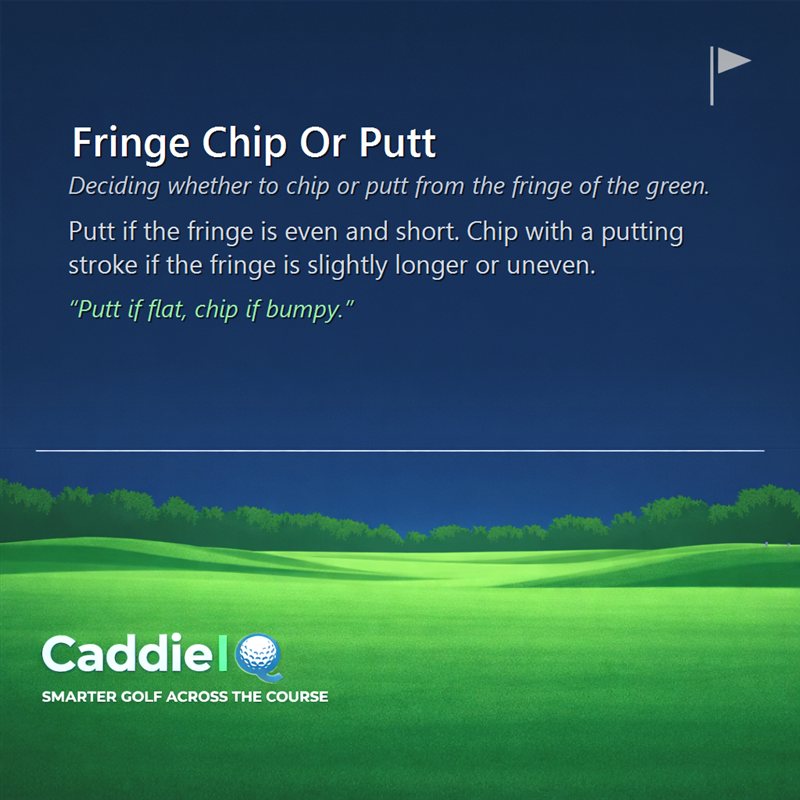
That moment when your ball rests just off the green, nestled in the fringe – it’s a familiar dilemma for every golfer. Do you reach for your putter, or grab a wedge? Making the right decision can shave strokes off your score, while the wrong one can lead to frustrating duffs or chunks. Let's demystify the fringe shot and equip you with the knowledge to choose wisely.
Why the Fringe Presents a Unique Challenge
The fringe isn't quite the fairway, nor is it the green. It’s an in-between zone with its own set of rules. The grass is typically a little longer and often less manicured than the green itself, creating unpredictable resistance. This variability makes a standard putting stroke risky if the grass is too thick, and a traditional chipping motion potentially too aggressive or prone to fat shots if the lie is tight. Understanding the lie is paramount to success.
The Fix: Assessing Your Fringe Lie
Your strategy should always begin with a thorough assessment of the lie and the path to the hole. Here’s how to make the call:
1. The "Pure Putt" – When the Fringe is Your Friend
If the fringe is short, tightly mown, and presents an even, smooth surface between your ball and the green, your putter is often your best friend. This scenario offers the highest probability of a consistent roll with minimal risk. Treat it as an extended putt:
- Technique: Use your standard putting grip and stroke. Focus on a smooth, pendulum motion, ensuring you strike the ball in the centre.
- Aim: Play it as if the fringe is part of the green, allowing for a slight deceleration as it transitions onto the putting surface.
- Benefit: High consistency, low risk of errors like fat shots or blading.
2. The "Putt-Chip" – The Hybrid Solution
This is where many golfers go wrong. When the fringe is slightly longer, a bit uneven, or has some resistance, a pure putt might snag and come up short. This is the ideal time for the "putt-chip" – a shot that combines the control of putting with a subtle lift to get through the grass.
- Club Choice: Depending on your comfort, you can use your putter or a low-lofted iron (like a 7-iron or 8-iron).
- Grip & Stance: If using an iron, take your putting grip. Stand a little closer to the ball than a standard chip, with the ball slightly forward in your stance.
- Stroke: The key is a putting stroke. Keep your wrists firm and use a pendulum motion primarily from your shoulders. The aim isn't to create height, but to ensure the clubhead glides through the slightly longer grass without digging. With an iron, the minimal loft will gently lift the ball over the initial fringe, allowing it to roll out like a putt.
- Swing Thought: Think "hit down, not up" to ensure solid contact, letting the club's loft do the work.
3. The "True Chip" – When You Need More Air
Occasionally, the fringe might be very thick, there might be an obstacle, or you need to carry the ball over a significant portion of the fringe to reach the green. In these instances, a traditional chip with a wedge is appropriate. However, always default to putting or the putt-chip first, as they are generally lower-risk options.
A Simple Drill: The Fringe Gauntlet
To master these shots, head to the practice green and set up a "fringe gauntlet":
- Place several balls in varying fringe conditions around the green – some tight, some slightly longer, some a bit uneven.
- For each ball, assess the lie and decide whether to pure putt or putt-chip.
- Focus on making clean contact and controlling your distance. Pay attention to how the ball reacts on different lies.
- Experiment with your putter and a low-lofted iron for the putt-chip to see which gives you more confidence and consistent results.
Mastering the fringe shot is about smart decision-making and precise execution. By understanding when to putt, when to putt-chip, and when to truly chip, you'll gain confidence around the green and save valuable strokes. For more personalised insights into your short game and overall course management, check out CaddieIQ – your free AI golf caddie.
Related tips
Get this kind of advice on every shot
CaddieIQ is your free AI golf caddie - instant club & shot advice, swing fixes and a daily tip.
Try CaddieIQ free